Sunday, September 16, 2007

Summer 2007 poll results

After an overw- helming response.. ......the survey revealed that a majority of readers have chosen Russia/ USSR as having the bloodiest history. There was no right or wrong answer since Russia and China have never been straightforward with their official records. With the violent formation of Russian states during the middle ages, the Crimean war, the Russo-Japanese war, WW1, the Russian revolutions of 1917, WW2, the cold war, the Afghan conquest, the repression of Hungarian and Czech revolutions and the Yugoslav secession wars, it has hosted a panoply of violent, unfortunate and sometimes unprovoked attacks. One way or another, Russia/USSR is a main contender for the unfortunate epithet that my readers have given it.

RUSSIA/USSR
BLOODIEST HISTORY
2007

End.

Thursday, September 13, 2007

Downfall by lack of commitment

September 12th 2007 – One day after the sixth unfortunate anniversary, two primary world powers announced major changes. Firstly, after less than a year in power, Japanese Prime Minister Shinzo Abe has resigned from office without explanation or warning. Secondly, my favourite butcher of Grozny, Vladimir Putin of Russia, declared that “it was necessary to shake things up for the upcoming elections”. This statement came as an explanation for his dissolution of parliament and expulsion of the current Prime Minister. Furthermore, Putin named his own Prime Minister, Viktor Zubkov, and is publicly backing him as the heir to the Russian presidency. These affronts to democracy (by abandonment or deliberate violation) could be devastating to the burgeoning democracies and more importantly, will probably inspire doubt in the democratic process for the affected nations.

Firstly, the Japanese situation is quite shocking considering that elections are nowhere near on the calendar and thus, the nation must replace the gouvernemnt by interim. Abe’s succession will be very difficult; seeing as Japan's constitutional monarchy is infinitely complex, it contains subtle pitfalls and traps that are, I think, inherent to the Japanese people. Speculation is running wild about his reasons and/or motivations. I think it might be safe to say that it has to do with the massive financial scandal in the agricultural/national production sector of his administration and the subsequent suicide of his minister of agriculture. Furthermore, with the following two agriculture ministers who were forced to resign after “financial irregularities” were noticed. Finally, with Abe’s defence minister was forced to resign after he announced that the 1945 Nagasaki and Hiroshima Bombing were “inevitable”. Today, Sept. 13th, he has apparently checked into a hospital citing “extreme exhaustion”. I don’t buy it but at least he didn’t commit suicide out of shame, which has become a very serious problem in Japan. Exhausted or not, Japan cannot afford this unnannounced abandonment of the democratic process. Abe did not die, he simply left everyone high and dry without any worry for succession or legacy. The japanese resolve for democracy is thus weakened from an already frail state.

Secondly, if you’ve followed my blog, you have seen the many ways in which Putin makes frequent controversial decisions and also, the ways in which he disregards international opinion about these. This latest measure taken by the Kremlin reeks of unconstitutionality; Putin has effectively deposed rival parties and installed his successor. I say he doesn’t care what we (westerners) think; I believe this is quite obvious when the best explanation he can come up with is “shaking things up”. He sure did. He takes us (international public) seriously enough not to lie to us, but that makes him even scarier on the geopolitical map… and even more evil looking as a person (in a bond villain kind of way).

These unforeseen shifts in national strength, especially within Russia, can have incredible and revolutionary effects. I say especially in Russia because it would not be the first time that the reigning man has dissolved or disregarded the authority of their senate/parliament called the Duma. In 1917, the last Tsar, Nicholas II Romanov, dissolved the Duma to avoid confrontation or debate on his rulings, an unwise choice. When the people protested in the streets in front of the St. Petersburg Winter Palace, Nicolas orderd the army to kill them all, a stupid choice. The army choose NOT to shoot their brothers and friends and turned against the gouvernment. I bet he didn’t know that it would lead to the February/march revolution, the Bolshevik takeover, Russia’s withdrawal from WW1, Stalin’s despotism, the Cold War, the Cuban missile crisis, the erection of the Berlin wall, JFK’s assassination, Roswell 1947, the disappearance of Amelia Earhart, the breakup of Ross and Rachel and the removal of Terry Schiavo’s feeding tube…. or maybe only the first few. Sorry, US history has taught me that it can be quite easy and patriotic to blame everything on the commies.

To make my point simple, repressing the fragile democratic process, as in Russia, or abandoning it in the face of adversity, as in Japan, can lead to confusion and lack of faith in the ideology. Russia’s democracy, or the facade they frequently present, is precarious enough without this exercise of red muscle. Authoritarianism will only lead to restrictions in democracy and increasing violent measures…by its nation and its administration. In parallel, Japan’s very young democracy was built on nuclear ruins and military dictatorship. Lack of constant vigilance will do nothing to maintain a tentative liberal democracy.

If you can't take the heat, get out of the way for someone else to take place, if you are a violent psychopath..........please don't send the KGB after me.

(Pictured: The Kremlin, overtaken by the bolshevik militia in 1917 - A very tired Shinzo Abe)


End.

Thursday, September 6, 2007

The cult of the leader

August 22nd 2007 – French magazine Paris Match has airbrushed a picture of French Prime Minister Nicolas Sarkozy. He was canoeing shirtless and a subtle love handle was digitally removed to polish the iconic image of the French leader. Recently, European media raved about the good shape and physical health of President Vladimir Putin as he was seen strolling through rural Russia…shirtless once again. The media have never been far from these seemingly nonchalant, yet extremely photogenic, vacationing figureheads.

We seem to be back to the absolutist age all of a sudden. Does a love handle imply that our leader will lead the country to financial ruin? Does a flabby chest mean degrading international relations? Does a sturdy and solid build guarantee a strong military organisation for a Nation? OF COURSE NOT! Therefore, the only other alternative implies that governments take us for idiots. They are trying to add a metaphysical aspect to their administration by controlling the physical/metaphorical image of its leader. This process has been called the “cult of the leader” by French historian Michel Winock. I should clarify that this last author actually qualified this concept as one of the six characteristics of totalitarian fascism.

In the 1920s, when Benito Mussolini took power in Italy, his fascist dictatorship greatly incorporated this notion. Mussolini’s office in Rome would always be lit, not to pretend as if he was always working, but to assert that he actually WAS always working. It is a process of semi-deification; the leader was superhuman and thus, was untouchable. Furthermore, “Il Duce”, as he was called, would tour the country to visit the rural and distant estates of his domain. He would then take off his shirt, pick up a scythe and harvest wheat with the farmers for a full day without stopping. Such feats of strength provided an idyllic and undefeatable figure (even icon), and therefore, these characteristics would apply to Italy. Also, it made the superman apparently immune to mistakes, demagogy and assassination attempts.

The Cult of the leader was greatly important in the fascist ideology because the “guide” was not a representative of the nation or its people; he WAS the nation and WAS the people. It rendered democracy redundant and unnecessary.

Sarkozy, Putin and maybe even George W. Bush being photographed on a Texas ranch have adopted this subtle attempt and superhuman status, a cleaver boost to the solidity of their respective administrations. There is nothing wrong with this and you could argue that it is absolutely harmless. I just don’t LIKE being taken for an idiot, do you?

(Pictured: Mussolini posing for a statue-like keepsake - the incredible Sarkozy and his incredible, disappearing flab.)


End.

Wednesday, August 22, 2007

Flexing a red muscle.

August 17th, 2007 – In a mounting display of force and effrontery, Russia has pulled another antagoni- sing stunt. President Vladimir Putin’s administration has reinstated long-range strategic surveillance, a measure that was abolished 15 years ago at the end of the cold war. Furthermore, these Tupolev-type bombers are taunting international powers by venturing a bit too close to their borders. So Far, these patrols have grazed the Alaskan North, the Canadian North and Scotland. The large American base in Guam was also flown over. Russia seems to be testing America, Canada and the U.K.'s resolves regarding contested land. They also seem to be demonstrating a fact that has been obvious many times through history, never underestimate or take your eye off of Russia.

This burst of tension began 2 month ago when Putin retracted Russia’s signature from cold war pacts, deplored an American-European missile defence pact and failed to sign the renewed Conventional Forces in Europe Treaty (CFE). This last piece of paper, aimed at the restriction in size of arms deposits and military personnel, was first signed in 1990 and was the culmination of Bush Sr.’s and Gorbatchev’s peace effort. Finally, a week ago, controversy broke out about the proprietorship of the Canadian North and the North Pole waters. These are rich with oil deposits and a retracting ice cap means an accessible terrain. Canada and Denmark are conducting negotiations while Russia has sent a mechanised mission to plant an underwater flag in the contested region; how very imperial. Although the action is dismissed as childish by Western powers, I see this as a very clear and very historically Russian sign of unwavering determination. The lines of conflict are being drawn.

With his withdrawal from this crucial pact and with his refusal to renew such a stalemate peace agreement, Putin will be free to start rebuilding a massive arsenal. This will lead to a similar effort by Western countries as well as by some new nuclear players such as India and Pakistan. You may call me overdramatic but we have just discovered joint military exercises between Russia (Oil, money, technology), Kazakhstan (Oil, land) and China (Money, Manpower, Communism). Not an axis of Evil but rather an Axis of essential military resources. I wish somebody with much more muscle than me would take serious notice of this. As some of you may remember, negligence and a laissez-faire attitude have recently been disastrous to the very same continent.

In 1933, a democratically elected Nazi party took control of the German Chancellery; some were concerned but were mostly content with a pro-business, anti-communist new neighbour. In 1936, Hitler re-militarized the Rhineland, directly breaking a stipulation of the WW1 peace treaty (Versailles). A gutsy move but the Western powers understood that this western province was, after all, IN Germany and populated by Germans. Later that year, Germany formally allied with Italy, creating a massive demographic and economic fascist bloc. “A new trading partner!”, people would say. Using the same logic as with the Rhineland, in 1938, the Nazis took over Austria and annexed it to Germany. The West agreed that Austrians WERE German and thus the move was shunned. Finally, when Hitler wanted parts of Czechoslovakia containing 3 million Germans (Sudetenland), they had to do SOMETHING. They sent British Prime Minister Neville Chamberlain to warn Hitler that he was not to transgress any more international borders and that any more belligerences would be met by unilateral military and economic response. At least, this is what should have happened in my head. In reality, Chamberlain signed a treaty with Hitler that gave a foreign land, inhabited by the Czech Germans, to Germany if they stopped their Empire building after that. I personally place this Munich accord near the top of a list of stupid treaties.

As Hitler was building in Germany, Mussolini was invading Africa and Japan was pillaging China, all that the international community would do was sit back, smile and impose a 5% restriction on cotton imports for this or that bad country. This is giving a slap on the hand to a child that stole 1 billion dollars worth pf Ethiopian resources, raped an entire Chinese village and was home in time to invade Poland.

It is a popular saying that we learn from our mistakes but it isn’t true. It is just a quaint notion that portrays human kind in a kinder light than we deserve.

Last week, with the revelation of these joint-military exercises and the reinstatement of bomber patrols, the American reaction was the one I was ready for. “In Washington, state department spokesman Sean McCormack played down the significance of Russia's move, saying: "We certainly are not in the kind of posture we were with what used to be the Soviet Union. If Russia feels as though they want to take some of these old aircraft out of mothballs and get them flying again, that's their decision," he told reporters.” (BBC News Service). The Russian efforts at antagonism are met with ridicule and marginality by it’s once, bitter rival. It is a bold non-move by the American Nation that was three years late in joining WW1 AND WW2, out of sight, out of mind.

People don’t learn, governments, doubly so. I don’t recycle because I will be dead in 100 years when things will get really bad. Governments have a lifespan of 4-10 years and thus apply this same logic to justify their laissez-faire attitude and lack of foresight. I’m off to build a bunker…

(Pictured:1936 parade for Mussolini's Visit to Berlin - Vladimir Putin at a parade for the remembrance of the 25 million fallen Russian soldiers of WW2)

End.

Tuesday, August 7, 2007

The words are mightier than the pen

For this week, I offer you the following, an excerpt from the book I am working on. It is a book of historical lists and contains common and uncommon knowledge from antiquity to today.


Most influential speeches in History

This list illustrates my personal choice of groundbreaking and influential speeches in Western history. It would be naive to think that these speeches single-handedly affected change. I propose that these jewels of oratory are the voicing of social, political and cultural trends at the time.

1. Moses – c. 1250 BC – The 10 commandments (The basis of Western law)

2. Cicero – 63 BC – Conjuration of Catilina (He foiled a Roman coup d’État and prosecuted its conspirators. Thus, the law and justice prevailed over summary judgements.)

3. Jesus – c. 33 AD – Blessed are the poor in spirit (This speech elaborated the following 2000 years in Western morality.)

4. Elizabeth 1st – Aug 9th 1588 – I have the heart and stomach of a king (Upon taking personal command of the defence of England against the invading Spanish Armada, the Queen gave this speech. It stands as a testament to female authority and power.

5. William Wilberforce – May 12th 1789 – Let us make reparations to Africa (This man and this speech pioneered the movement for the abolition of slavery throughout the British Empire. It was finally accomplished in 1809)

6. Maximilien de Robespierre – Dec. 3rd 1792 – Louis must perish because our country must live (This speech elaborated and justified the violent downfall of European monarchies through the promotion of the ideas of the Enlightenment. This led to the following 50 years in which Europe formed nations and renounced absolute, divine-right monarchy)

7. Thomas Jefferson – March 4th 1801 – Equal and exact justice to all men (Dressed in plain clothes and without escort, this American president’s inaugural address emphasized the class-blindness of the law.)

8. Abraham Lincoln – Nov. 19th 1863 – Gouvernment of the people, by the people and for the people (This oration is the most quoted in history. It confirmed the holy and ethical virtue of liberty and equality among men.)

9. Vladimir Illyich Lenin – April 15th 1917 – Long live the World Socialist revolution (When philosophers theorised about equality among men, Lenin promoted the violent overthrow of the established order to accomplish it.)

10. Winston Churchill – June 18th 1940 – This was their finest hour (Amidst the preparations for the imminent invasion of Britain by the Nazis, Churchill defiantly reiterated the undying courage and valour of democracy in the face of tyranny.)

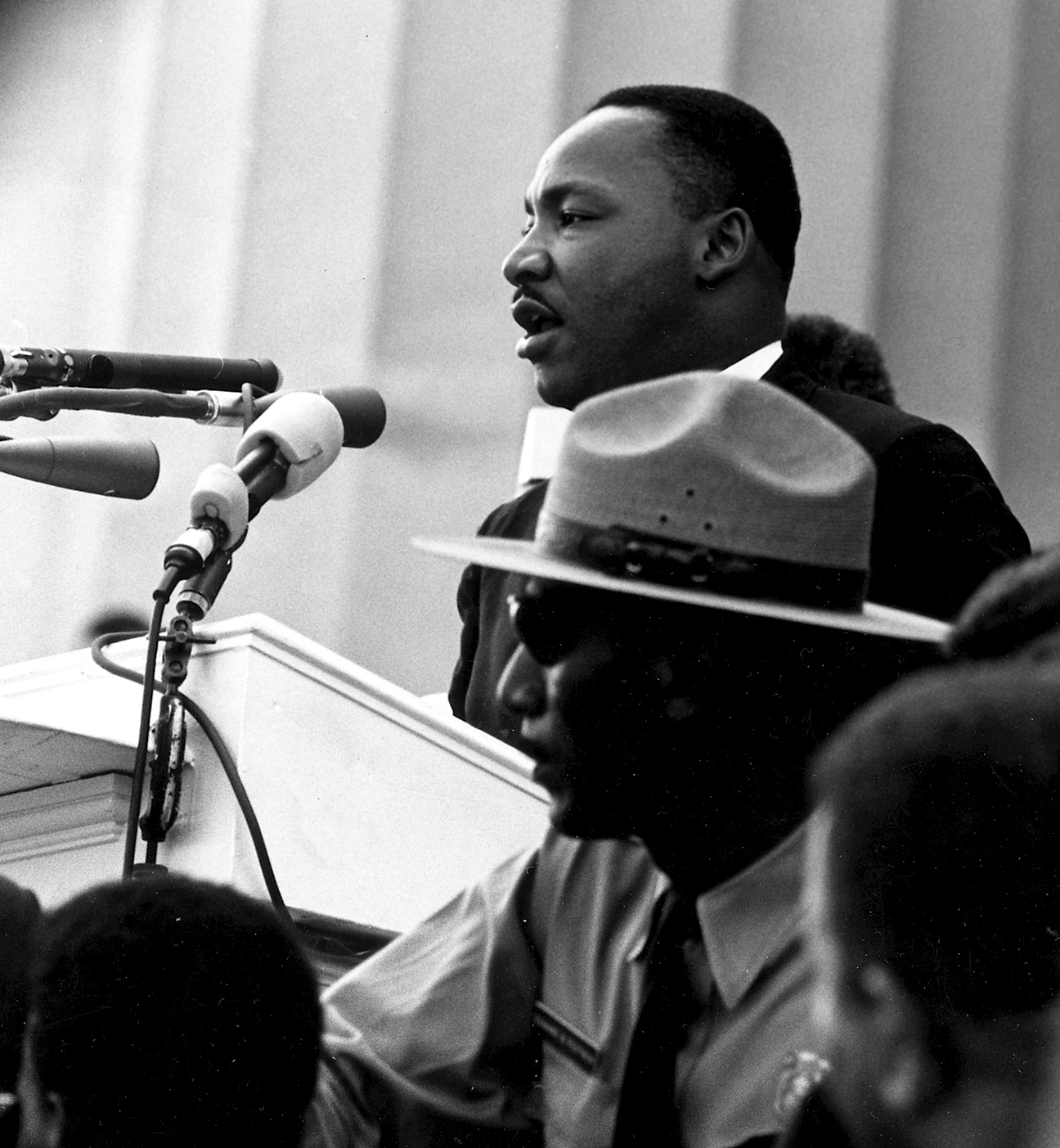
11. Dr. Martin Luther King – August 28th 1963 – I have a dream (Dr. King proudly shouted his hope that racial discrimination should fall as the last major bastion of ignorance.)

End.